Some of the most important work happening in a community doesn't look particularly dramatic. It looks like a room full of people showing up to another meeting.
But the meetings of Training Resources Advocacy Connector (TRAC), East Central Indiana's regional early childhood collaborative, were never just another calendar invitation. They were a place to share challenges, test ideas, celebrate progress, and imagine solutions to a problem no single organization or county could solve alone. They were a place for hope, resolve, and resilience at a time when early childhood professionals were being asked to do more with less, families were struggling to find affordable care, and employers were confronting the consequences of a child care system that too often keeps willing workers on the sidelines.
As this season of TRAC's work supported by Regional Economic Acceleration and Development Initiative (READI) funding comes to a close, it deserves more than a final meeting or a line in a grant report. It deserves to be celebrated for what it made possible—and recognized for what must continue.
A funding chapter can close without diminishing the work, relationships, and responsibility it leaves behind.
The challenges TRAC brought people together to address are not going away. According to the East Central Indiana Childcare Impact and Action Plan (September 2025), the estimated annual economic impact of the early care and learning crisis in Indiana is $2.2 billion. Families face child care bills that can rival housing payments, often at a point in their lives when their careers and savings are still developing. Providers must balance the rising costs of delivering quality care with wages that make recruiting and retaining talented educators difficult. And when families cannot find care that is affordable, accessible, and aligned with their working hours, parents may be forced to reduce their hours or leave the workforce altogether.
This is not simply a parenting problem. It is an education issue, a workforce issue, an economic development issue, and a community issue.
Child care is essential infrastructure, and solving its challenges requires a regional response.
TRAC helped East Central Indiana approach it that way. Through regional collaboration, partners across Blackford, Delaware, Fayette, Grant, Henry, Jay, Randolph, Rush, and Wayne counties could better understand local needs while learning from one another. Conversations brought together early childhood professionals, schools, employers, economic developers, and community leaders to examine the realities facing families in urban, rural, and mixed communities.
That shared understanding mattered. Employers were identifying child care as a barrier to recruitment and retention. Families needed dependable care that fit their budgets and schedules. Providers needed resources, professional development, and opportunities to expand without compromising quality. The region needed a way to connect these challenges rather than treat them as isolated problems.
TRAC created space to do that work together.
Regional collaboration is most powerful when it leads to meaningful change in local communities.
In Delaware County, BY5 helped bridge regional vision and local action by serving as a convener and host for TRAC training events. These gatherings brought early childhood professionals together to strengthen their practice, share knowledge, and access professional development responsive to the realities of their work. This partnership illustrates an important part of TRAC's legacy: regional collaboration depends on local organizations willing to bring people together, create opportunities for learning, and strengthen the connections that help communities move forward. BY5 helped ensure that Delaware County's early childhood professionals could participate in and benefit from the broader regional effort.
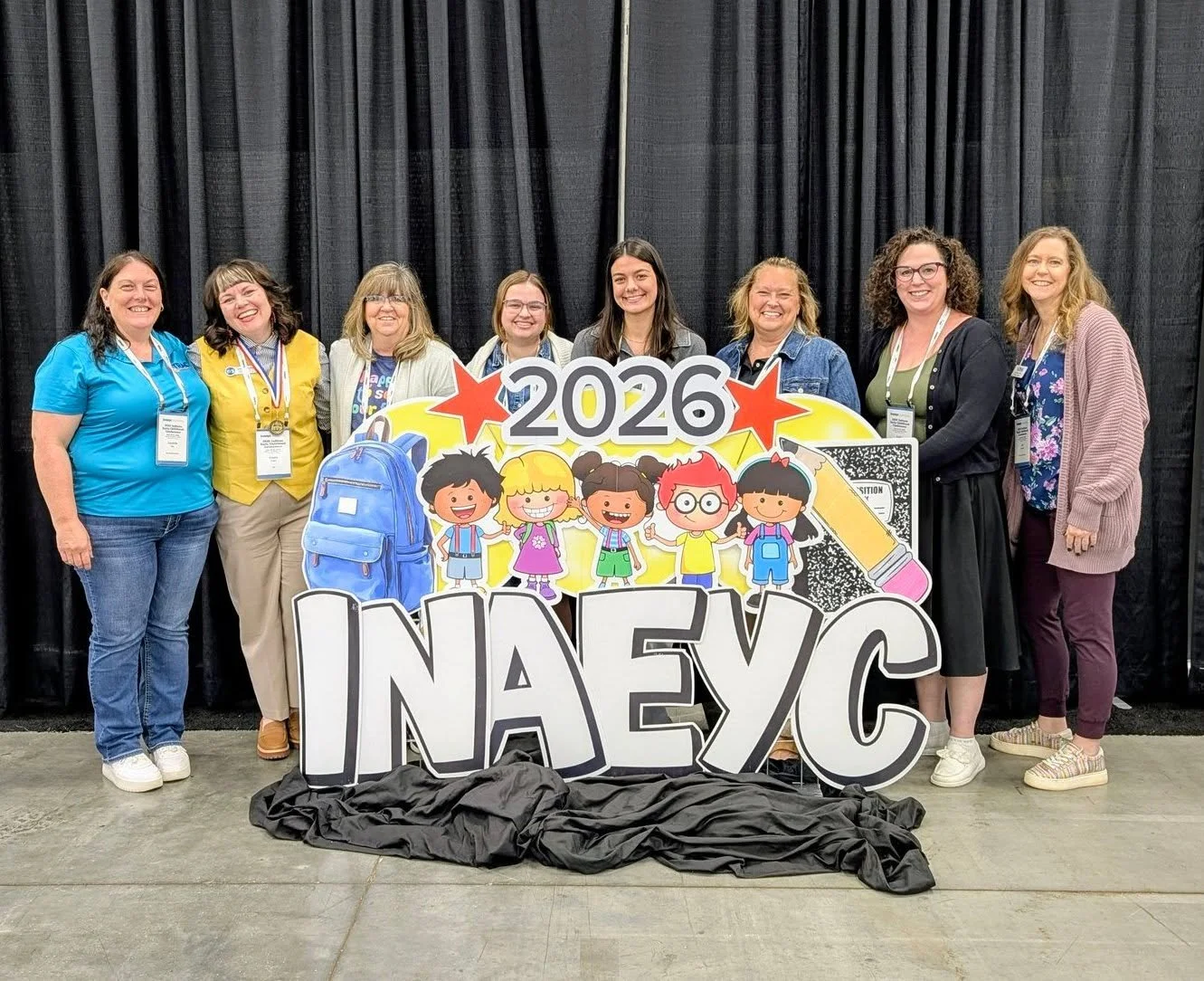
Members of TRAC and BY5 teams at the 2026 INAEYC Conference alongside Natalie McIntire, Director of Helen Lieber Early Learning Academy in Hartford City, Indiana.
Behind every strong early learning environment is an educator who deserves support, resources, and the opportunity to grow.
Across three years, TRAC's educator trainings recorded 833 participant attendances, representing more than 550 individual educators. Training topics responded to the realities of the profession, including trauma-informed practices, de-escalation, sensory regulation, early literacy, and learning through play. Many of these opportunities reflected requests from licensed and registered providers for training that addressed their day-to-day needs while meeting professional development requirements. Local partners, including BY5 in Delaware County, helped make these opportunities accessible to the educators who needed them. These opportunities supported professionals who are essential to children's development but do not always receive the recognition, resources, or compensation their work deserves. High-quality early learning depends on qualified, supported educators. Investing in them is investing in children.
When providers have the right resources and guidance, an idea can become a lasting community asset.
The Regional Activity Support (RAS) grants offered another tangible way to turn collaboration into action. Across two funding rounds in 2024 and 2025, TRAC awarded a combined $344,000 to support 40 projects across the region. These investments helped providers improve facilities, create learning environments, purchase educational materials and play equipment, and expand capacity. Collectively, the projects supported the creation of more than 200 additional child care slots.
Behind every number is a local story.
At Monroe Central, what began as an effort to provide child care for school employees grew into a community-serving early learning academy. With RAS support and TRAC's guidance, the program expanded resources and capacity while developing an early childhood education pathway that gives high school students opportunities to earn a Child Development Associate (CDA) credential and gain practical experience. A child care program became a family resource, a potential career pipeline, and an investment in the local workforce. The academy is also exploring year-round solutions to help families access reliable care beyond the traditional school calendar.
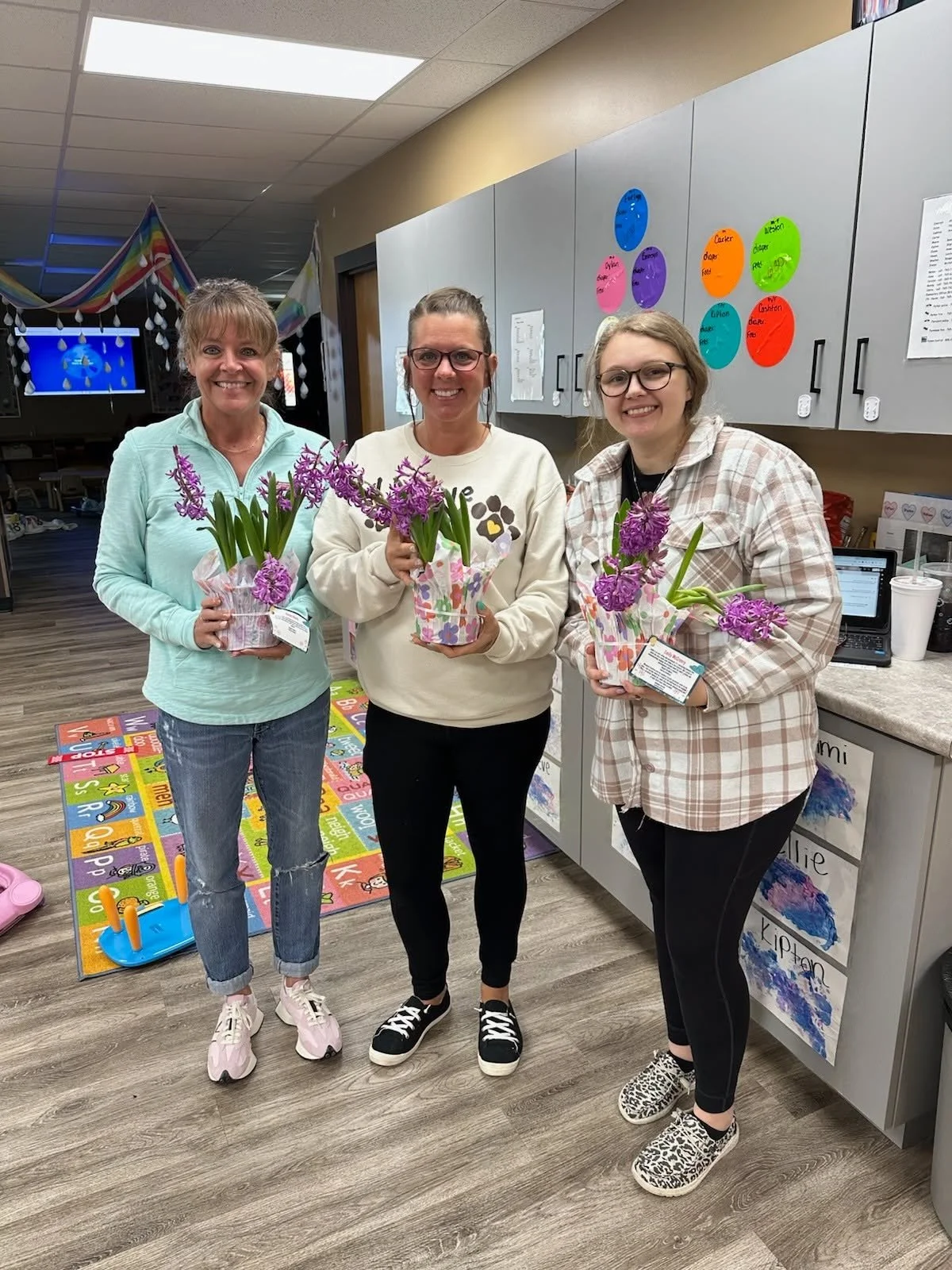
Monroe Central Little Cubs Academy educators getting a flower pick-me-up thanks to TRAC.
At Hazelwood Christian Preschool and Extended Learning Center in Delaware County, grant support helped strengthen facility security, support families and teachers in infant and toddler classrooms, and create a transition classroom offering additional learning opportunities to children who needed support following pandemic-era disruptions. Hazelwood serves many first responder families whose parents work demanding shifts and may be called into the community at any hour. For these families, dependable child care means knowing their children are safe, loved, and cared for while their parents serve the community.
These are not abstract outcomes. They are examples of local organizations building solutions that reflect the people they serve.
Early childhood is not separate from economic development; it is one of the conditions that makes economic development possible.
The regional work also helped keep child care in the economic development conversation. In Wayne County, employer surveys identified child care assistance as one of employees' most important desired benefits, while cost and hours of operation emerged as significant barriers. That work continues through local collaboration and research into the relationship between child care and employee retention.
The economic consequences of these barriers are measurable. According to the region's Workforce Impact Analysis, East Central Indiana has an estimated 2,207 “work-willing” parents: people eager, willing, and able to return to full-time employment but unable to do so because they cannot afford or access reliable child care. If these parents were able to return to full-time work, their annual earnings could total between $82.2 million and $102.5 million. Their participation could generate an estimated $175.4 million to $231.5 million in additional gross regional product, alongside an estimated $2.5 million to $3.1 million in additional state income tax revenue and $1.5 million to $1.9 million in additional county income tax revenue.
When families cannot access child care, the consequences extend far beyond the household. The entire region misses out on workers, wages, business activity, and economic opportunity.
These estimates represent potential gains, not guaranteed outcomes. But they reinforce why child care must be treated as essential workforce infrastructure, not simply a private family expense. Reliable care can help parents return to work, help employers recruit and retain talent, and strengthen the economic vitality of communities across East Central Indiana.
The need remains, even as the funding landscape changes.
None of this means the region has solved its child care challenges. Providers continue to face financial pressures, families continue to struggle with affordability, and access remains uneven. The funding landscape has also become increasingly uncertain, making it harder to plan for the long term. That uncertainty is precisely why the relationships built through TRAC matter.
The READI-supported season of this regional effort may have reached its conclusion, but the broader work of early childhood collaboration in East Central Indiana continues in a new iteration. The knowledge shared, partnerships strengthened, programs expanded, and local solutions developed do not disappear when a grant period ends.
In Delaware County, BY5's role as a local convener and host of TRAC training events offers a practical example of how regional priorities can become local opportunities. Continuing to connect early childhood professionals, support providers, and engage community partners will remain important as the region works to sustain and build on this progress.
We can celebrate a successful chapter without confusing it for a finished story.
TRAC demonstrated what becomes possible when a region treats early childhood not as an expense to be managed in isolation, but as a shared investment in its people and its future. It created room for providers to ask for help, employers to name their challenges, educators to strengthen their practice, and community leaders to turn concern into action.
The next chapter will require continued collaboration, sustained investment, and a willingness to recognize that the cost of inaction is borne by children, families, businesses, and communities alike.
For everyone who convened, contributed, trained, built, renovated, shared data, supported providers, or simply kept showing up: thank you. You helped make more than 200 additional child care slots possible. You helped educators grow. You helped local programs imagine what they could become. And you strengthened a regional network that can continue to learn and lead together.
A funding chapter has closed. The need has not. Neither has the responsibility—or the opportunity—to keep building a region where children can thrive, families can work, and early childhood professionals can build sustainable careers.
The work continues wherever communities choose to invest in their youngest children.
That is the legacy worth carrying forward.